
When Students Design the Learning, Everything Changes
An LCPS Thinkering capstone project shows what happens when outdoor learning is built with students, not for them


At Ashley Barkley’s school, there is a playground.
But until now, there hasn’t been a place to go outside and actually learn.
Not recess. Not free time. Learning.
That absence became the starting point for Ashley’s Thinkering Fellowship impact project, developed in partnership with Loudoun County Public Schools. What followed wasn’t a top-down initiative or a prefabricated plan. It was a process rooted in listening to students and trusting them to help design something better.
“I only have one class in each grade level,” Ashley explained. “So it’s about a hundred students, which actually makes it much easier for me to get all of my students involved in decisions and things that we want as a school.”
She took advantage of that closeness immediately.
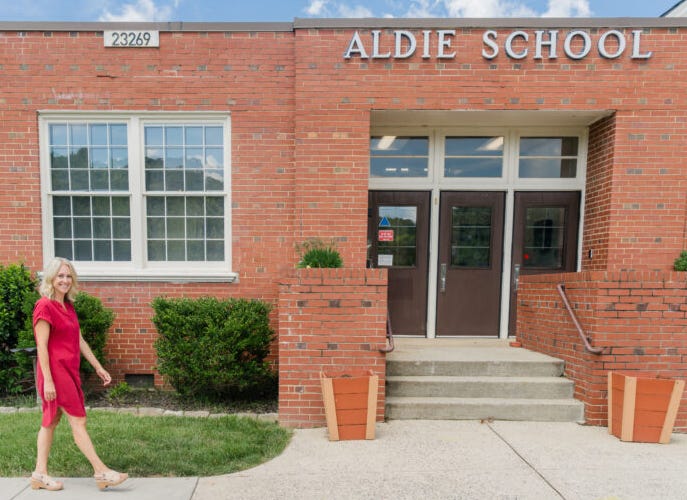
“When I started this project, I was able to go into each classroom and talk to the students and see what they really want, what they’re excited about, what would make them happy to come to school and learn.”
That question changed everything.
Agency Comes First. Research Follows.
What Ashley wasn’t sure about at first was whether students would actually want an outdoor learning space. She’d worked in other schools where similar spaces existed but weren’t always used.
This time was different.
“I wasn’t sure if they actually were missing having an outdoor learning space,” she said. “But I was very excited to see that the kids really wanted to have the space and actually were into it so much that they did their own research.”
That research wasn’t symbolic. Students looked up studies, summarized findings, and explained the academic, social, and emotional benefits of outdoor learning in their own words.
“One of my students that has ADHD was like, ‘I found that there’s benefits to students that have ADHD from learning outside.’ So we were like, nice, let’s throw that in there too.”
The project quickly shifted from an idea to a student-led case for change.
This Is About Academics, Not Escaping Them
Ashley was clear about one thing. This wasn’t about doing less work or lowering expectations.
“Our students are very high,” she said. “A lot of them come in already knowing a lot of the things that they’re being taught. So they need something more than just the regular textbook.”
The outdoor space is designed to deepen learning, not replace it.
“We need them to have the opportunity to get deeper into the concepts that are being taught. The best way to do that is hands-on learning and experiments where they can really touch and feel and work with the things they’re learning about instead of just reading about them or seeing them on a screen.”
That distinction matters. This isn’t enrichment. It’s pedagogy.
Learning Outside Connects What School Often Separates
As students explored what outdoor learning could look like, they began connecting disciplines naturally.
“They were like, if we’re studying butterflies, why can’t we have butterflies?” Ashley said. “We need butterfly bushes. We need milkweed.”
From there, the thinking expanded.
“You can be learning about a plant. You can be counting seeds. You can be measuring leaves. There’s a lot of ways to combine math with science.”
Some students wanted science. Others wanted reading.
“So they thought, if we could just go outside and read. That’s why they’re looking for a cozy corner.”
The space became a platform for cross-curricular learning rather than a single subject area.
Human Needs Are Academic Needs
The students were especially drawn to research around attention, anxiety, and well-being.
“A lot of our students have trouble paying attention,” Ashley shared. “We have a lot of students with ADHD and just a lot of squirrely students. Sitting inside in a classroom all day long is not going to help those kids.”
Students were quick to point out that being outside even two hours a week could improve mood, reduce stress, and increase engagement.
“They were excited to see that it wasn’t only science they could do,” she said. “Even math scores increasing just from doing their work outside.”
Human needs weren’t treated as separate from academics. They were understood as foundational to them.
Constraints Don’t Kill Innovation. They Shape It.
Ashley’s school sits in a floodplain, which means no permanent structures can be built. Instead of stopping the project, that constraint sharpened it.
Students proposed movable seating, shade solutions, storage, raised garden beds, collaborative tables, and rain barrels to water plants.
“They wanted a space where the whole class could get around a table together and work together,” Ashley said.
This wasn’t a wish list. It was a practical plan shaped by real conditions.
This Is How Change Gains Momentum
As Ashley presented the project, the response from the Thinkering team was immediate.
“What you did here is create a way for buy-in for outdoor learning within a school,” Evin Schwartz noted. “You worked with the students. You gave them agency.”
That agency turned into ownership, research, and a shared mission.
“These are the kinds of things we can make louder,” he said. “When you have kids explaining not only what they want but the research behind it, that’s powerful.”
The next phase will bring subject matter experts, research support, and funding conversations to help move the project from vision to reality.
But the foundation is already there.
Why This Matters Beyond One School
Ashley’s project is not just about an outdoor space. It’s about what happens when educators stop working in isolation and start building with students and partners.
Humanizing education is not an individual act. It’s a collective one.
When educators are supported, when students are trusted, and when systems make room for experimentation, learning changes.
And it scales.
An Invitation Out of the Silo
This project didn’t happen because Ashley had all the answers. It happened because she asked the right questions and didn’t try to build alone.
If you’re an educator with an idea that won’t leave you alone, you don’t have to carry it by yourself.
Building the future of learning is a collective effort.
And the work is better when we do it together. You are already the pulse of this movement - to get active, click below!