
When First Graders Are Trusted With Real Work
Sara Edwards’ LCPS capstone shows what happens when learning is built with students, not delivered to them

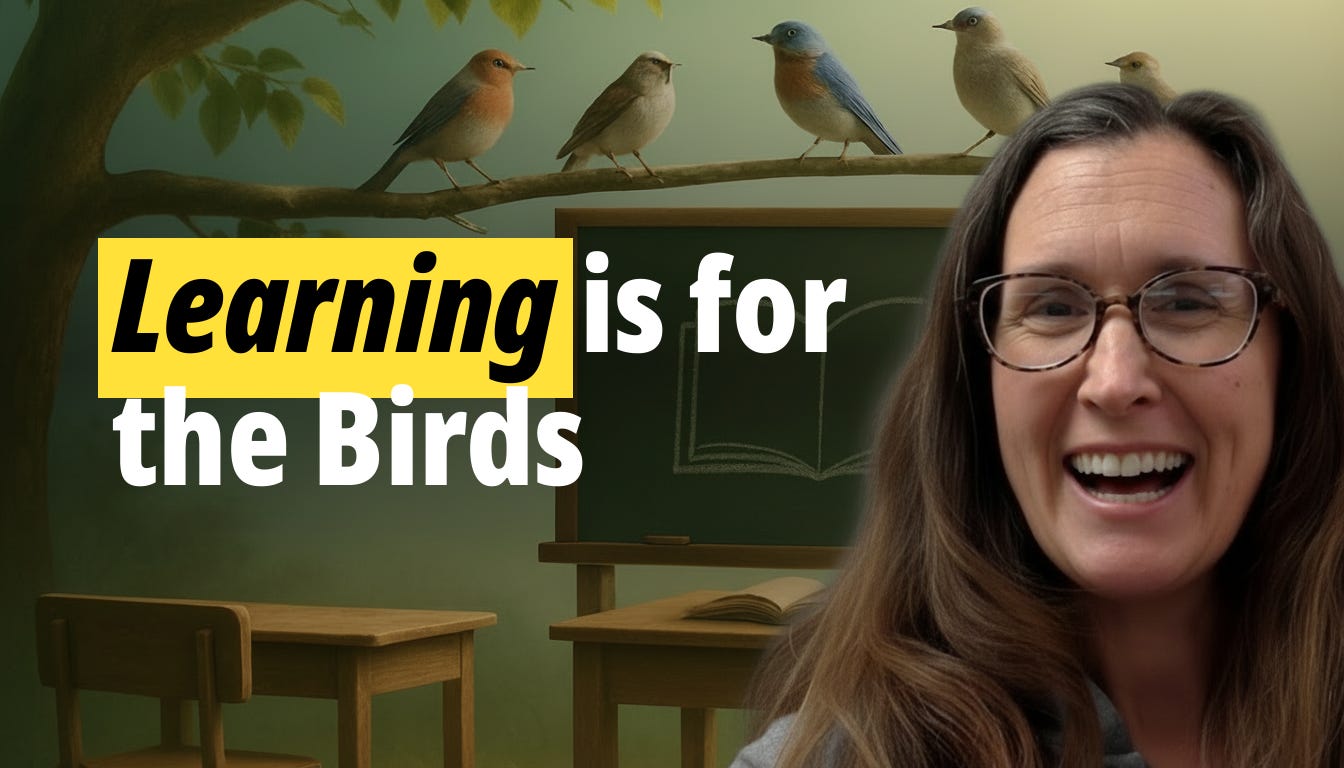
Sara Edwards has been teaching first grade for twenty years. She knows her curriculum well. She knows her students even better.
What she also knows is this: if you want children to care deeply about something, you have to let them live it.
“I believe that if you want kids to be interested in something and care about it for a super long time,” Sara said, “you’ve got to get them out there. They’ve got to live it. They’ve got to observe it, understand it.”
That belief became the foundation of her Thinkering Fellowship capstone with Loudoun County Public Schools, a project called First Graders Empowered by Feathered Friends.
What followed wasn’t a unit pulled from a binder or a program purchased from outside the school. It was a student-led journey that wove science, literacy, math, social studies, and leadership together through outdoor learning.
And it worked because the students owned it.
Student Choice Changes Everything
Sara didn’t begin with a solution. She began with a question.
“I literally said to them, we want to talk about what happened with our project and how can we tell people what we learned.”
What the students created next surprised even her.
She offered microphones and recorded them. There was no script. No rehearsal. No coaching.
“That was totally organic and quite honestly, very awesome.”
The project itself followed the same pattern. After exploring the UN Sustainable Development Goals and brainstorming ways to help the earth, the students voted. They chose birds.
From there, the work deepened.
They observed birds outside.
They researched in PebbleGo.
They pulled books from the library.
They kept bird journals and recorded findings.
“All the while,” Sara explained, “they had their little bird journal notebooks and they recorded all of their findings.”
This wasn’t pretend research. It was real inquiry driven by curiosity.
Outdoor Learning as Serious Academic Work
As the project evolved, Sara deliberately connected it to required curriculum.
During social science units, students mapped the outdoor classroom and planned where bird feeders, bird baths, and shelters should go. They counted tables and benches. They measured space. They analyzed shapes and proportions.
“One little love nugget counted all the windows that were around us in the area and drew each window with the window panes,” she shared. “Somebody’s got their compass rose smack dab in the middle of their map.”
The work was joyful. It was also rigorous.
“Our project includes science, writing, reading, math, and social science curriculums,” Sara said. “I mean, it’s got everything.”
Students weren’t doing less academic work. They were doing more of it, with purpose.
Engagement Comes From Movement and Meaning
Sara was clear that outdoor learning didn’t distract her students. It grounded them.
“If you can get student choice coupled with an outdoor learning environment,” she said, “engagement is off the charts.”
Her first graders needed movement. They needed variety. They needed application.
“Some days I take these kids out for outdoor learning time and I think, is it too cold? Are they going to complain about their little fingers? No complaints. Total engagement.”
The payoff showed up in comprehension.
“And their comprehension of what we’re trying to learn, because it’s applied in a new way, is also awesome.”
One of her favorite moments came when students questioned whether what they were doing counted as schoolwork at all.
“They go to me, are you sure this is math? Because this is really fun.”
This Is a Shift in How Teaching Happens
Sara is honest about what makes this possible. Experience helps. Confidence helps. But mindset matters most.
“I had to make the paradigm shift,” she said. “I wanted my kids outside learning more because I know it’s good for their brains.”
She stopped asking whether a lesson had to look a certain way.
“Is this something that a six year old can do?” she asks herself. “Then they do it.”
Her students run morning meetings. They speak in front of peers. They make decisions.
“This project was easier in my classroom because of the way I run the classroom and empower the kids.”
The work didn’t add to her plate. It reorganized it.
“I don’t have to teach that that way,” she said. “I can do this or that.”
What Happens Next Matters
When asked what comes next, Sara didn’t answer on her own. She went back to the students.
“I have to ask the tiny humans.”
Their ideas were immediate. They wanted to invite other classes and staff outside. They wanted to teach others about native birds. They wanted to expand into pollinator gardens and organic plantings.
“They want to share their bird knowledge,” she said. “They want to teach staff members and classes.”
This is where the work moves beyond one classroom.
As Evin Schwartz noted during the conversation, the real opportunity is sustainability. What happens to these students next year. How this kind of learning continues across grades. How a single project becomes a model.
Why This Work Matters Beyond First Grade
Sara’s capstone is not impressive because her students are young. It’s impressive because they are trusted.
This project shows what happens when educators stop working in isolation and start designing learning with students and partners.
Humanizing education doesn’t happen alone.
It happens in community.
When educators are supported, when students are given real agency, and when systems make room for experimentation, learning changes.
And it spreads.
An Invitation Beyond One Classroom
Sara didn’t build this project because she had extra time or resources. She built it because she trusted her students and refused to work alone.
If you’re an educator with an idea that won’t leave you alone, you don’t have to stay in the silo.
Humanizing education is a collective effort.
And the work is stronger when we build it together. Join us in impact!