
She Saw Something the Classroom Couldn't.
Thinkering Fellow Megan Pulis started an after-school science club on instinct. Her capstone is turning what she stumbled into something every underrepresented gifted student deserves by design.

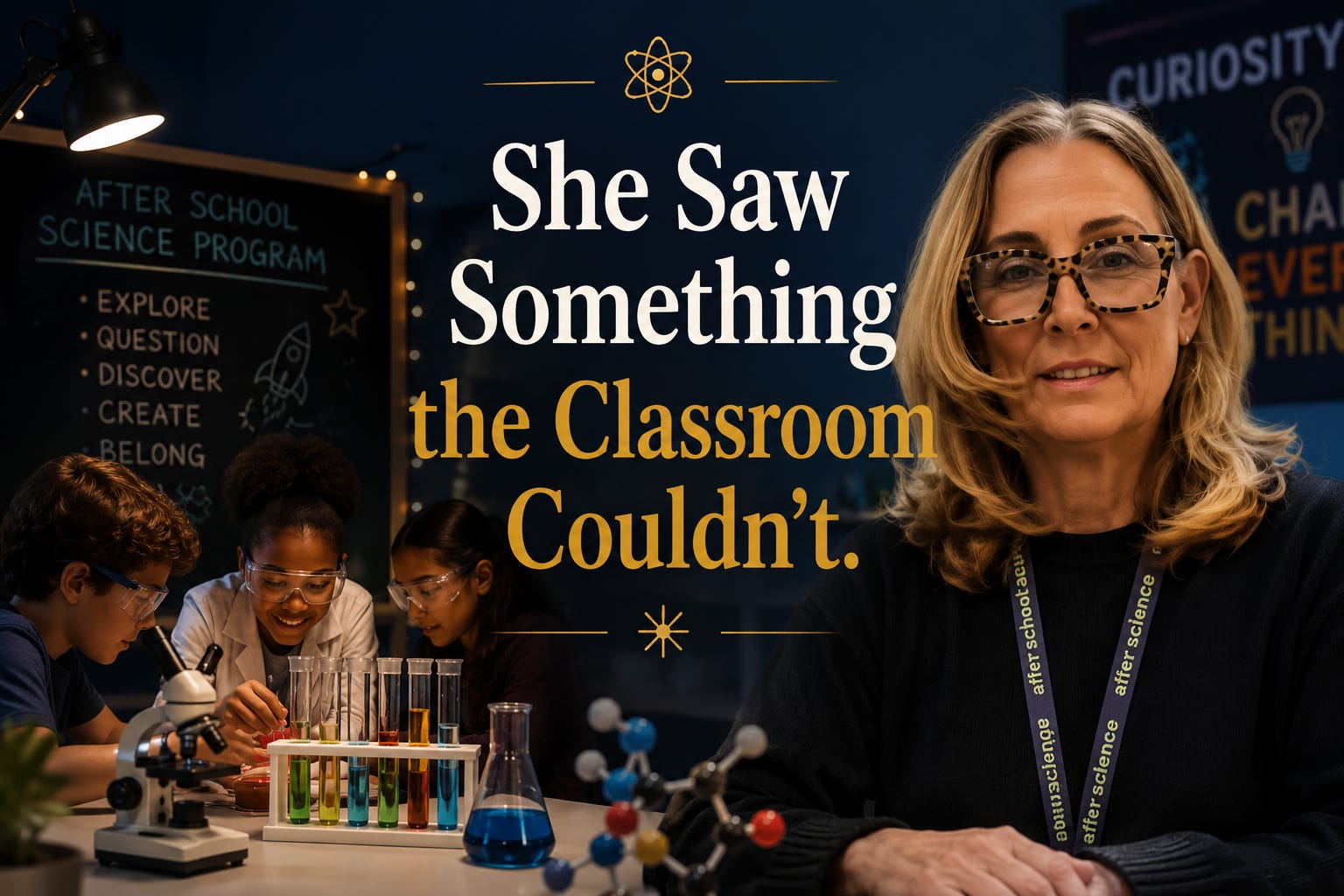
Megan Pulis will tell you the first version was not high quality. She will say it plainly, without apology, because the whole point of what she is building now is that the first version still worked.
She is a part-time GT educator at an Aurora-area school, and last fall she started an after-school science club. She did not have a framework. She did not have a replicable toolkit or a scalability plan. She had a group of kids who were hard to reach inside the regular school day, and she had an instinct that getting them outside of it, after the bell, away from the curriculum, doing something they could not fail at in any way that would follow them and might show her something she could not see otherwise.
She was right. And what came next became her capstone.
The Problem She Was Trying to Solve
The students who end up in Megan’s care occupy a complicated position in their school. Many of them are gifted. Many of them also have learning gaps, missed instruction, interrupted schooling, circumstances that left holes in the foundational knowledge that standardized systems use to identify potential. The tests and benchmarks that are supposed to catch gifted learners were not designed for kids whose paths to the classroom were not straightforward.
Pulling them out of class for GT enrichment is not always an option. Pull them out, and they miss core instruction. Keep them in, and the gap between what they could be doing and what they are doing quietly widens.
“I can’t pull them out of their classroom, because they’re missing their core instruction.” — Megan Pulis, Thinkering Fellow
So she went to the margins of the school day instead. After school. Voluntary. No grades, no stakes, no test coming at the end of it. Just the scientific method, a question, and enough room to try something.
What Happened at the Science Fair
Half of the students who came to the club went on to the district science fair. Megan watched parents show up grateful in a way she had not seen before. She watched students stand in front of judges and talk about their projects, about the thing they had investigated, the variable they had changed, the conclusion they had reached, and she watched them understand, maybe for the first time, that they were capable of that.
“When it was finished, and we had gone to the district science fair, I just had so much gratitude from parents and the students. They were so happy, and proud of the work they had done.” — Megan Pulis, Thinkering Fellow
She went home thinking about the students who had not gone. Kids who were uncertain about what would be expected of them. Kids who might have gone if there had been a school-level science fair first, a lower-stakes rehearsal before the district stage. The structure that would have gotten more of them there was not complicated. It just did not exist yet.
That is the project.
Reimagining the Science Club
The version Megan is building now is not a different idea from the one she ran last fall. It is the same idea, given the resources and planning it deserved from the start.
The design is intentionally accessible: inquiry-driven, inclusive, and low-cost. The experiments use everyday materials, food, household items, things that do not require a grant to buy. Colleen Kelly, a partner Megan connected with through the Thinkering network, reframed what a science fair project could look like for this age and context. It does not have to be a complicated multi-variable experiment. It can be one question, one changed variable, one result that a kid can stand behind and explain. Warm soda versus cold soda. That is science. That is enough.
“She helped me to see that it doesn’t have to be these big, grandiose experiments. We could have one experiment where each student changes out a variable, and they would have a project they could present and feel good about.” — Megan Pulis, Thinkering Fellow
The timeline she is building toward puts the club launching in mid-September, leaving students enough runway to prepare for a school-level science fair in December before the district fair in January. Last fall, she did not get started until November. She knows what those missing weeks cost.
The Identity Problem
Underneath the logistics is something harder to engineer. Megan described it with the kind of precision that comes from watching the same pattern across years of students: her kids do not see themselves as scientists. Not because they lack the ability. Because they have never been given a reason to.
“They don’t see themselves as scientists. It’s hard for them to know what they want when they don’t know what they don’t know.” — Megan Pulis, Thinkering Fellow
She found her way into this problem through Atomic Habits — the idea that when something becomes part of your identity, it becomes sustainable. She is not just trying to run a science fair. She is trying to give students the experience of being someone who does science, so that the habit of thinking scientifically has somewhere to attach.
That is why the community partnerships matter so much to the next version of this program. The Denver Zoo. The Denver Botanical Gardens, with its Día de los Muertos marigold planting. Colorado State’s Little Shop of Physics. DPS Community Resources, which can bring speakers in for a school science night. These are not extras. They are the curiosity spark , the thing that has to happen before a kid can want to investigate something, because they have to first believe that the world of science is one they are allowed to enter.
“Students are starting to think of themselves as scientists and critical thinkers.” — Megan Pulis, Thinkering Fellow
The Gift That the Club Revealed
The most striking moment in Megan’s capstone presentation was almost an aside. She mentioned it matter-of-factly, the way teachers mention things that surprised them once but now feel obvious.
Two students signed up for the science club who had not been identified as gifted. By interacting with them in that setting — after school, hands-on, away from the curriculum — Megan saw something she could not have seen in a regular classroom. Both students were identified as gifted last month.
“There were two students who actually signed up for the club, and just by interacting with them where I normally wouldn’t have seen them, they were identified as gifted, because I was able to see something in them that couldn’t be seen in a classroom with the demands of, you know, we’re trying to get ready for the tests.” — Megan Pulis, Thinkering Fellow
The system had not found them. The science club did.
What She Is Building Next
Megan’s goal for the next version of the program is simple to state and genuinely difficult to do: build something that does not depend on her.
A replicable toolkit. Student leadership, where fifth graders mentor the younger grades and the knowledge transfers person to person rather than sitting in one teacher’s head. A keep-scrap-modify planning cycle at the end of each year so the program improves continuously rather than resetting. Alignment with school and district goals so that it does not have to justify its existence every time there is a new administrator.
“How it lives beyond me, to have a replicable toolkit that other people feel confident using.” — Megan Pulis, Thinkering Fellow
That ambition is exactly what the Thinkering Collective team recognized during her presentation. The project is not a vision without a roadmap. It has already happened once. The path forward is documented, the partnerships are real, and the evidence — kids presenting at the district science fair, kids getting identified through the club that the classroom missed — is already there.
What it needs now is room to grow.
Megan Pulis is a Thinkering Fellow and GT educator at an Aurora-area school. The Thinkering Collective fellowship supports educators in designing and launching projects that humanize learning and build real community impact. For fellowship information and applications, visit www.thinkeringcollective.org