


It started as a quick check-in. Three people who had been connected through the kind of conference floor introduction that usually leads to nothing. Somewhere in the middle of it, something clicked, and what was supposed to be fifteen minutes became a partnership, a new fellowship, and this conversation.

That is how the best things in education start. Not with a grant application. With a phone call between people who realize they are working on the same problem from different angles. That is WHY Thinkering exists … to help all of us come together.
Who Was in the Room
Dr. Melissa Sadorf is the executive director of the National Rural Education Association. Before that she was a superintendent of a single-site district of 600 kids spread across 600 square miles of corn and cows in rural Arizona. She was the business manager, the HR director, the grants coordinator, and everything else except the bus driver, because she does not have a CDL and she would like everyone to know that was intentional.
Cari Warnock spent decades moving through school leadership before landing in ed tech, where she became the person vendors call when they need someone to translate education for them. She knows both sides of the table, what it looks like when a school is trying to figure out if a tool is worth buying, and what it looks like when a company is trying to figure out if a school is worth serving. That dual fluency is rare and she knows exactly what to do with it.
Rural Is Not a Monolith
The first thing Melissa wants anyone outside rural education to understand is that rural is not one thing. It is not a small school in a field. It is not a single image or a single set of challenges. Rural looks completely different in the Southwest than it does in Appalachia than it does in the upper Midwest. The federal locale codes used for grant eligibility often miss the actual texture of what makes a community rural.
What is consistent, across all of it, is this: the school is the hub. It is where the community gathers. Where Friday night football happens. Where weddings and celebrations take place. Where the largest employer in the area signs its paychecks. And where kids who are often far from anywhere else get their one shot at a launch into whatever comes next.
“Those kids deserve a launch into whatever it is they want to do next. And the community cares about that.” — Melissa, NREA
One in five students in the entire American education system attends a rural school. Twenty percent. When rural is not at the table, the conversation is missing a fifth of the students it is supposed to be about.
What Vendors Get Wrong
Cari has been spending the last several months talking to founders and CEOs who are trying to figure out how to survive a post-ESSER world where budgets have tightened and the liquid money of a few years ago is gone. The ones doing it right are asking a completely different set of questions than the ones struggling.
The wrong question: how do we hit quota?
The right question: do I even understand who I am selling to?
Evin told a story from his early days running an ed tech company. First contract, ten thousand dollars. He asked the district what success would look like. They told him: if teachers use this five times a year, we are happy. Five times a year. For an everyday product. He learned more about what schools actually need from that one sentence than from anything else in those early years.
“It’s not about a one and done, walking in, here’s the quote, here’s the PO, pay the invoice. It’s really about a relationship and an investment into that community.” — Cari Warnock
The districts that are going to keep their vendor partners are the ones where the vendor showed up knowing the difference between a rural school in southern Utah and an urban district in Houston. The ones that treat the badge scan as the finish line are going to find themselves without renewals.
Failure as Data
The conversation took a turn into failure and stayed there for a while, which was one of the better detours.
Melissa made the point that in rural communities, there is nowhere to hide. The org chart is flat. Everyone knows what everyone is doing. Which means the leader who is willing to say out loud that they got something wrong creates the only environment where anyone else will admit the same. She goes first. Every time.
“It’s framing failure as data. That didn’t work. Let’s try it again. I’ll go first. I’m the leader. I’m going to expose the mistakes I’ve made because I want you to feel comfortable exposing your own.” — Melissa, NREA
Evin brought up a company that has a Director of Failure on the org chart. The actual title. The actual job description is innovation, because the only way innovation happens is if people are allowed to get things wrong and learn from it without being punished for trying. Schools are working against years of the opposite culture. Leaders who model the other way are the ones who eventually get somewhere real.
Impact Beyond the Booth
Here is the thing that started as a check-in call and became a formal partnership.
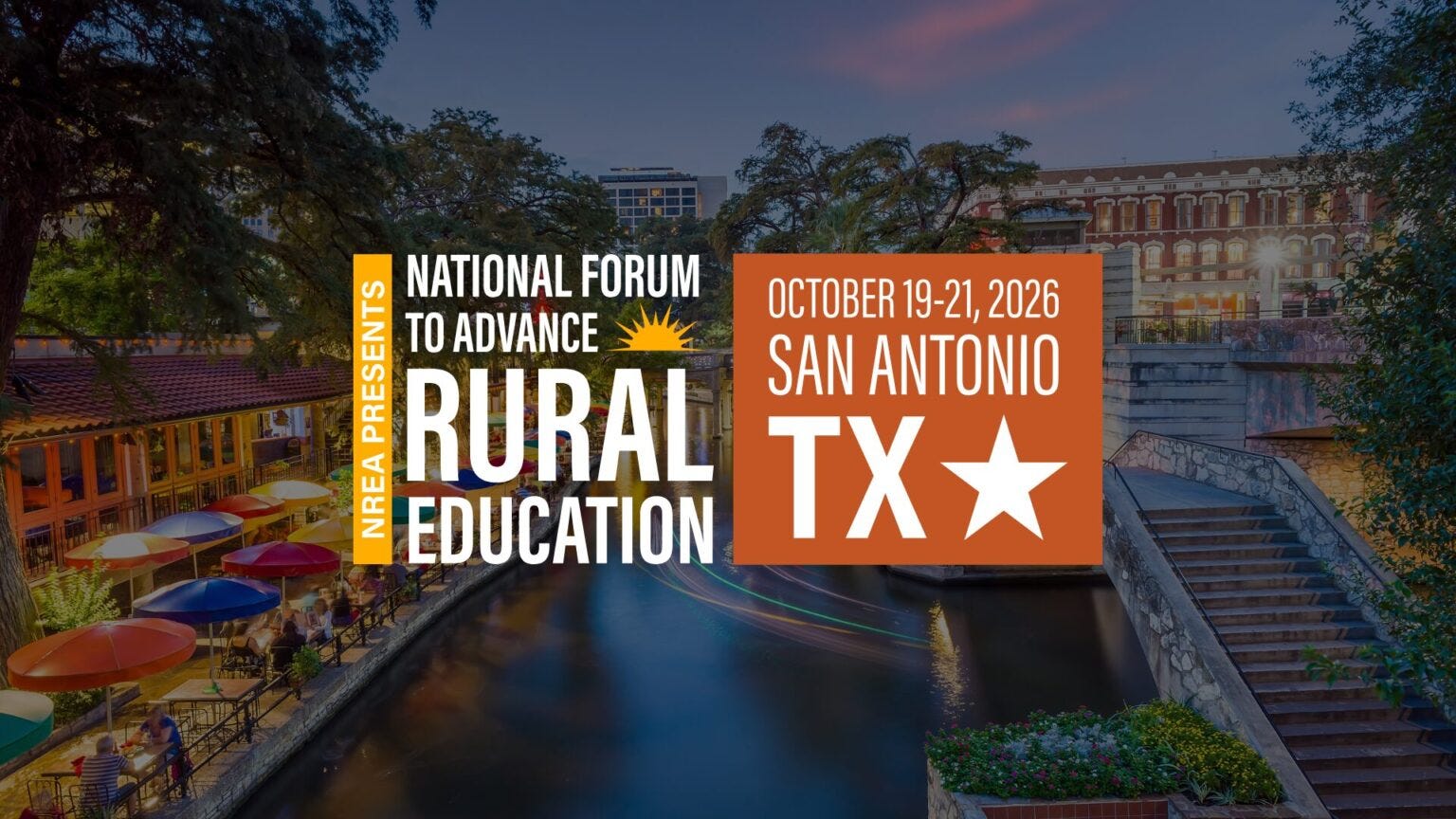
Thinkering will be at the National Forum to Advance Rural Education conference in San Antonio in October. But not just to cover it. The collaboration is built around a concept called Impact Beyond the Booth, which is exactly what it sounds like. Instead of vendors showing up to scan badges and hand out tote bags, the conference will include a dedicated session for vendors that is interactive, no-tech, and designed to actually educate the people in the booths about what rural educators need, what their communities look like, and what it would mean to genuinely invest rather than just attend.
On the school side, rural educators who are innovating out of necessity, and there are a lot of them, will have a platform and a spotlight for the first time in a way that reaches beyond the conference hall.
And in February 2027, Thinkering will launch a rural education fellowship specifically designed to bring that community in. MORE TO COME LATER THIS WEEK!
“What started as a quick check-in call really has become one of the most energizing conversations I have had ever.” — Melissa, NREA
If There Were No Red Tape
Evin closed the same way he always does. No ceiling, no budget, no restrictions. What happens?
Cari said wall to wall means all for all. Every kid between these walls gets a seat. No exceptions. No tours that skip certain classrooms. No students left out of what the building has to offer. A hundred and eighty days, every one of them used on purpose.
Melissa said rural educators need a seat at the national table, and if one is not offered, she would like them to bring a folding chair. The one-in-five stat is not going to stop being true just because the conversation keeps happening without them in the room.
The NREA conference is in San Antonio, October 19 through 24. Information at nrea.net. If you are a rural educator, a vendor trying to figure out how to genuinely serve that community, or just someone who wants to understand the twenty percent of American students whose schools are not in the room when most of these decisions get made, this is the place to be.
Thinkering will be there. Find us, if you dare! Check out a recent fellow, Hilary Lozar, who is a rockstar focused on rural Montana!
To join our fellowship programs, or join us in making impact - visit ThinkeringCollective.org


